
Every agent a passport
Eight agents run co-Founded by AI and minagi. Each now gets a passport documenting task, model, data, and owner. Just filling it out surfaced seven improvements.
We run eight agents in-house: a Friday cleanup that tidies the brain. A chat on mi-nagi.com where Mira answers visitor questions. Workflows for blog images, carousels, and video with Mira and Kai. A scanner that crawls the Kickstarter market twice a month. Each of those eight runs on a language model, works with our data, and either produces or ships something.
On October 14, we read an article by Job van den Berg on ai.nl. His argument: agent safety starts with visibility. At any moment, you know what an agent does, which model it runs on, what data it uses, and when it went live. His tool for that is called the agent passport. One document per agent, updated with every change, reviewed each quarter.
That same afternoon, the idea lands in our company brain.
What a passport is
Think of it as a car's service manual. The manual doesn't drive anywhere on its own. At each service, you pull it out, and a buyer can see at a glance what's happened to the car.
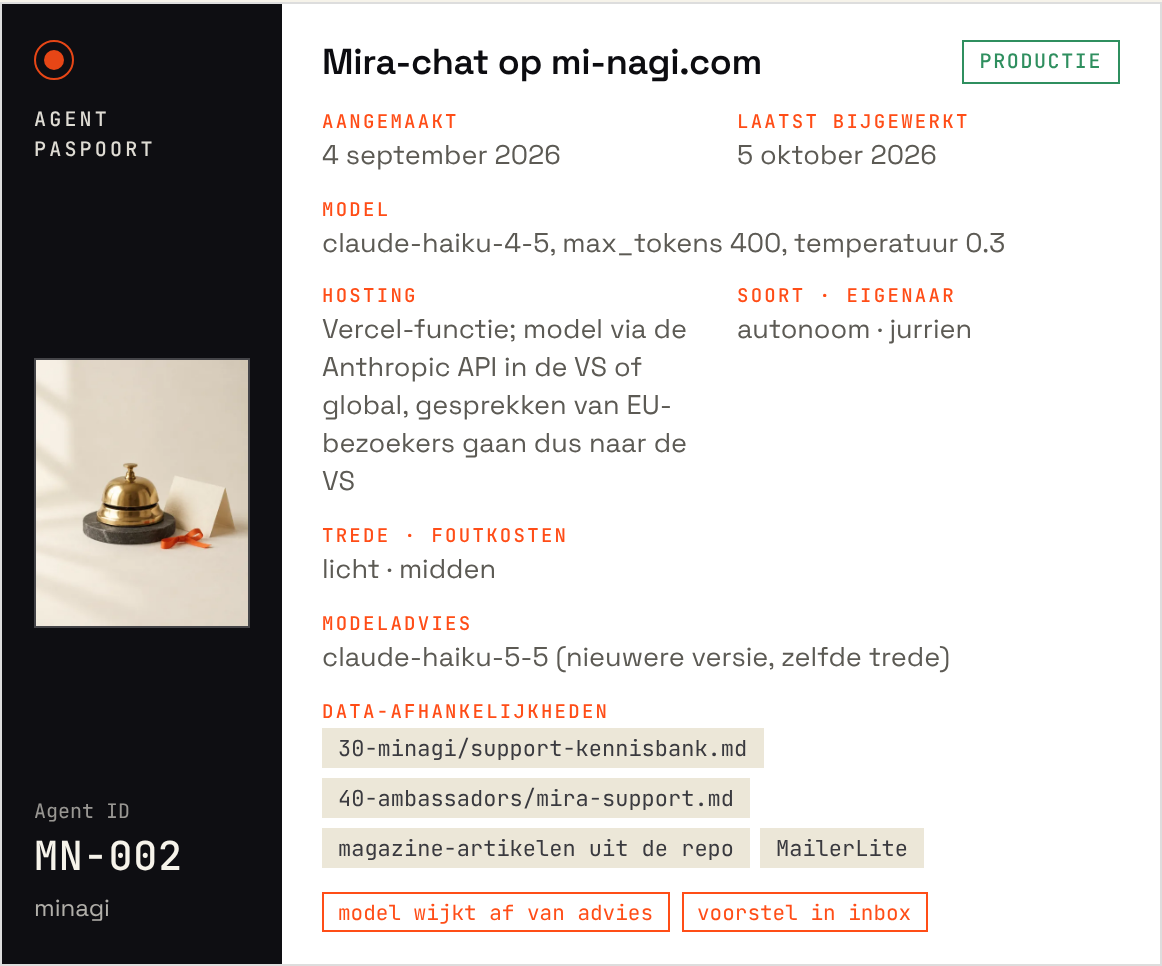
Our passport is a short markdown file in the 80-agents/ folder of the brain. It follows the fields from the article: a unique number, the phase (development, test, production), creation and update dates, model and hosting, the task in two sentences, when a human takes over, and the data sources the agent uses.
We add five custom fields:
- Type. Autonomous (runs without oversight) or workflow (a human starts it and approves the output).
- Permissions. What the agent reads, writes, and sends, and whether it asks permission first.
- Owner. Geert-Jan or Jurriën. One name per agent.
- Cost of error. Low, medium, or high. What do AI costs run if this agent makes a mistake?
- Tier. Light, workhorse, or top. The model follows the cost logic.
Those last two fields turn out to be the most interesting. The launch scanner gives timing advice for our Kickstarter campaign. A reasoning error there costs months. For that task, we use a top-tier model. The chat on mi-nagi.com answers product questions from a fixed knowledge base. A light, fast model does that fine, for a fraction of the price.
The numbering is simple: CF- for co-Founded by AI, MN- for minagi, SM- for seimono. A number never recycles, even after archiving.
Three ground rules
- Passport first, then production. A new scheduled task, chat, or workflow goes live only with a completed passport.
- If the model, prompt, permissions, or a data source changes, update the passport first.
- Review every quarter. The first review round is January 14, 2027.
Visible in the brain
A registry in a folder gets forgotten. So brain.html, the page that renders our entire brain as one file, gets an Agents button. Behind it stands Mira as director. She knows every passport: what an agent does, which model, what data, and when it went live. We decide, Mira maintains oversight, the agents execute.

Below that, each agent gets a card. An orange label flags what needs attention: a model that deviates from the recommendation, an open question, a proposal sitting in the inbox.
Just filling it out works
Drafting eight passports takes us an hour. That hour surfaces seven improvements, before we change a single line of code.
- The launch scanner runs on outdated product specs. The prompt describes a walnut wooden block and five fixed positions (the first, obsolete minagi). The design now sits on a stone base.
- The Mira chat follows that same old description. The knowledge base tracks our decisions perfectly. The moment we make a material choice, the knowledge base updates with it. Otherwise Mira tells visitors about a product we're already building differently.
- Chat conversations from European visitors route through the US. Anthropic's API currently supports two regions: US and global. Those wanting to keep conversations in Europe can use Claude via AWS Bedrock in Ireland or Stockholm. One item for our privacy policy.
- The Friday cleanup has five unused integrations. And that agent sends email autonomously. Fewer integrations, lower risk.
- The indexing check has done its job. A task with no schedule and stale context. It's moving to archive.
- The blog images have three model rules spread across three notes. The passport makes it one.
- Two scheduled tasks run on the default model. The question "which model?" stayed open that way. The passport nails it down.
The passport works. You describe what you think is running, and see where reality has since moved.
An agent monitors the passports
A registry gets stale. So the registry itself gets an agent: CF-005, the passport check. On the first Monday of the month, it sets each passport alongside the actual scheduled tasks. Does the model, schedule, integrations, permissions match? Are the product facts in prompts and knowledge base aligned with our decisions? Is any task running without a passport?
It logs its findings as a proposal in the brain's inbox and sends us a push notification. It doesn't update things itself. The Friday cleanup picks up the report automatically, and one of us decides.
What you can do with this
Start by counting. Most companies running AI have more agents than they think. A scheduled task, a chatbot, a fixed prompt recipe in a team: anything counts once it does something in your name or ships something.
Let cost of error pick the model. Ask per agent what a mistake costs. That answer sets the model, and keeps you from running the most expensive model everywhere or the cheapest one everywhere.
Have an agent maintain the registry. Visibility takes upkeep. A monthly check by an agent, with a human reviewing the proposals, keeps the registry current without extra work from you.
For seimono (more on that later, sneak preview at seimono.com) the first number is already reserved: SM-001.
Sources
- Job van den Berg, "Hoe zorg je ervoor dat een AI-agent veilig is?", ai.nl, October 14, 2026: https://www.ai.nl/artikelen/job-van-den-berg-hoe-zorg-je-ervoor-dat-een-ai-agent-veilig-is
- Cloudmagazin, "AWS Bedrock, Anthropic API or self-hosted AI inference", April 22, 2026: https://www.cloudmagazin.com/en/2026/04/22/aws-bedrock-anthropic-api-or-self-hosted-ai-inference/