Governance Model Part 2
Build a Governance Model in 6 Steps
Last week we described the four layers of our governance model. This week: the build sequence in six steps, and what comes next: an organizational chart where people and dozens of agents work together.
Twenty Agents Per Company
At co-Founded by AI, eight agents are currently live. An average mid-market company will soon have maybe twenty running. Each agent applies knowledge, executes tasks, and touches systems. That raises a question every entrepreneur recognizes: who is responsible for what?
Our answer is a governance model with four layers. The Brain holds business knowledge, the Harness manages the operating environment and boundaries, the language model thinks, and Tools provide the apparatus. A passport connects those layers for each agent. In "Four Layers and a Passport" we explain each layer. Here we focus on the build.
Construct your agent system in this order. Six steps from Brain via house rules, passport, Harness, and model to learning and oversight.
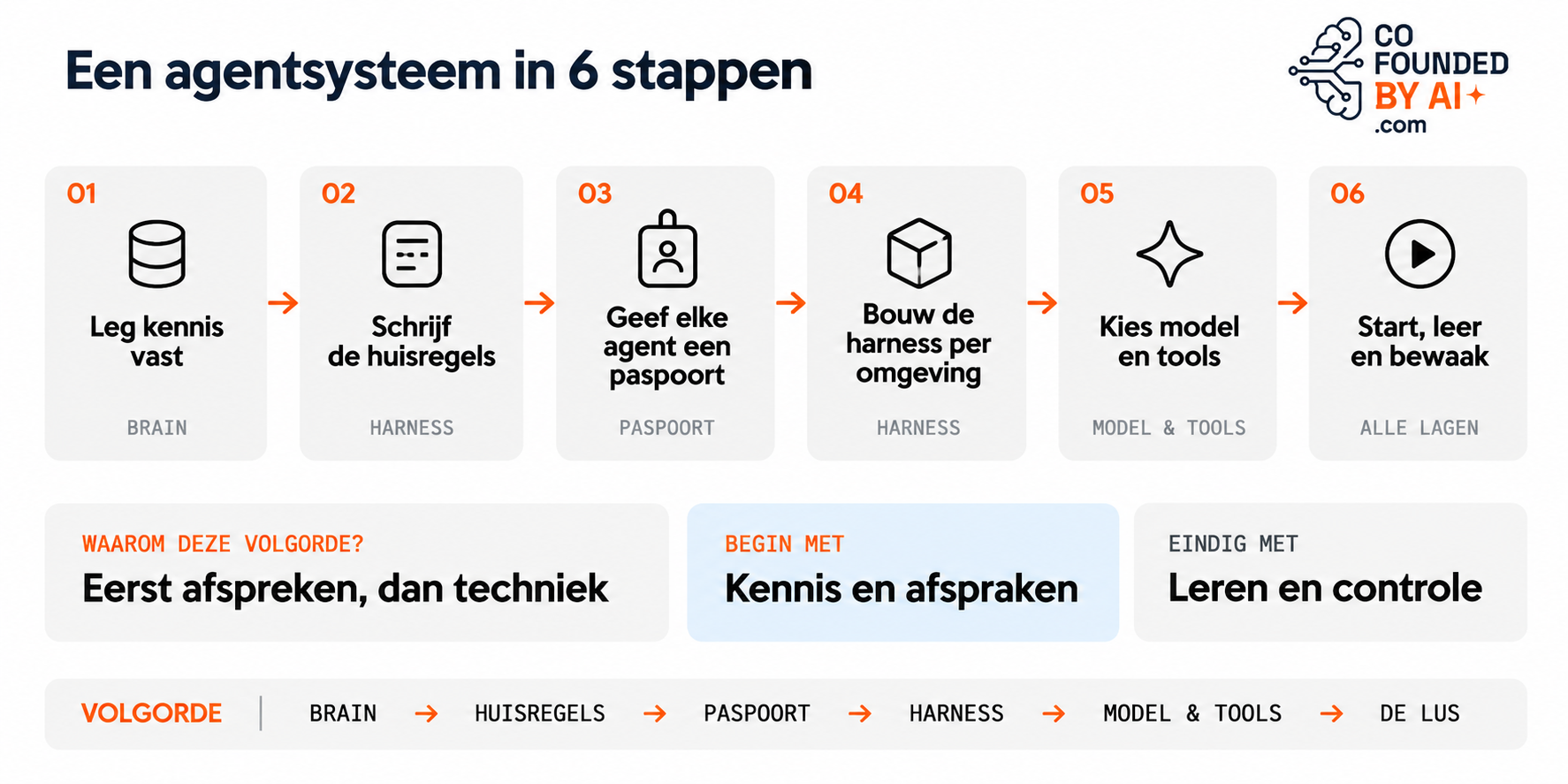 Visual: co-Founded by AI's step-by-step roadmap
The sequence provides structure. Knowledge and agreements come first; the technology follows.
1. Capture the Knowledge
Gather decisions, product facts, brand guidelines, and operational procedures into a shared Brain. Give each topic its own file, each decision a date and a rationale. Test the source with a new colleague. Have them answer your ten most common customer questions using only these files. Where they get stuck, knowledge is missing.
2. Write the House Rules
Document where agents fetch information, which tasks they complete independently, and when they escalate to a human. Have every working environment reference the same baseline rules. When an agreement changes, update it in one place. These rules form the starting point for technical architecture.
3. Give Every Agent a Passport
Map all your agents, including any standing task a team member executes weekly on the company's behalf. Describe the task, data sources, permissions, error costs, and assign an owner. When we filled out eight passports, it immediately surfaced improvement opportunities, from outdated instructions to redundant integrations. The passport is the blueprint for execution.
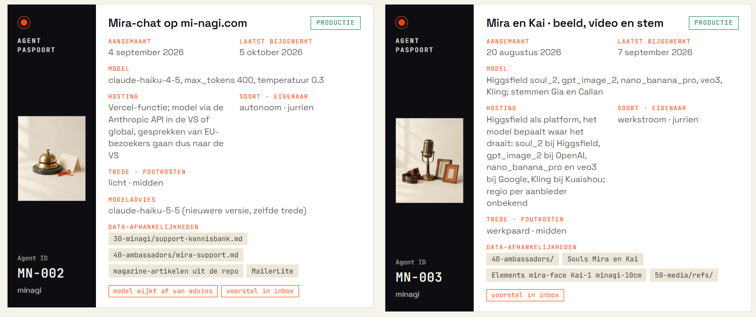 Visual: two passports from our register: MN-002, Mira's chat on mi-nagi.com, and MN-003, image, video, and voice from Mira and Kai.
4. Build the Harness
Translate the passport into the operating environment around the language model. Set a budget and a maximum number of work loops. Grant access to only the systems the task requires, maintain a log, and set up independent final review. If an action needs human approval, the software waits for that sign-off. This way, every agreement gets a switch.
5. Choose Model and Tools
Weigh the task's complexity and error costs. An agent fetching answers from a fixed knowledge base starts with a lightweight model. A thorny analysis needs more reasoning power and extra review. Give each agent the tools that fit the job. Test the setup with representative tasks.
6. Organize Learning and Oversight
Agents deliver new knowledge as proposals. A human decides what expands the Brain. In our case, that happens at Friday roundtable. Oversight agent CF-005 compares every passport to practice each month; every quarter we run a broader review. When a model, instruction, permission, or data source changes, we update the passport first. That way, every agent stays aligned with the agreements.
From Passport to Organigram
The passports do more than serve eight agents. They form the foundation for an organization with dozens of agents. For that, we draw an organigram.
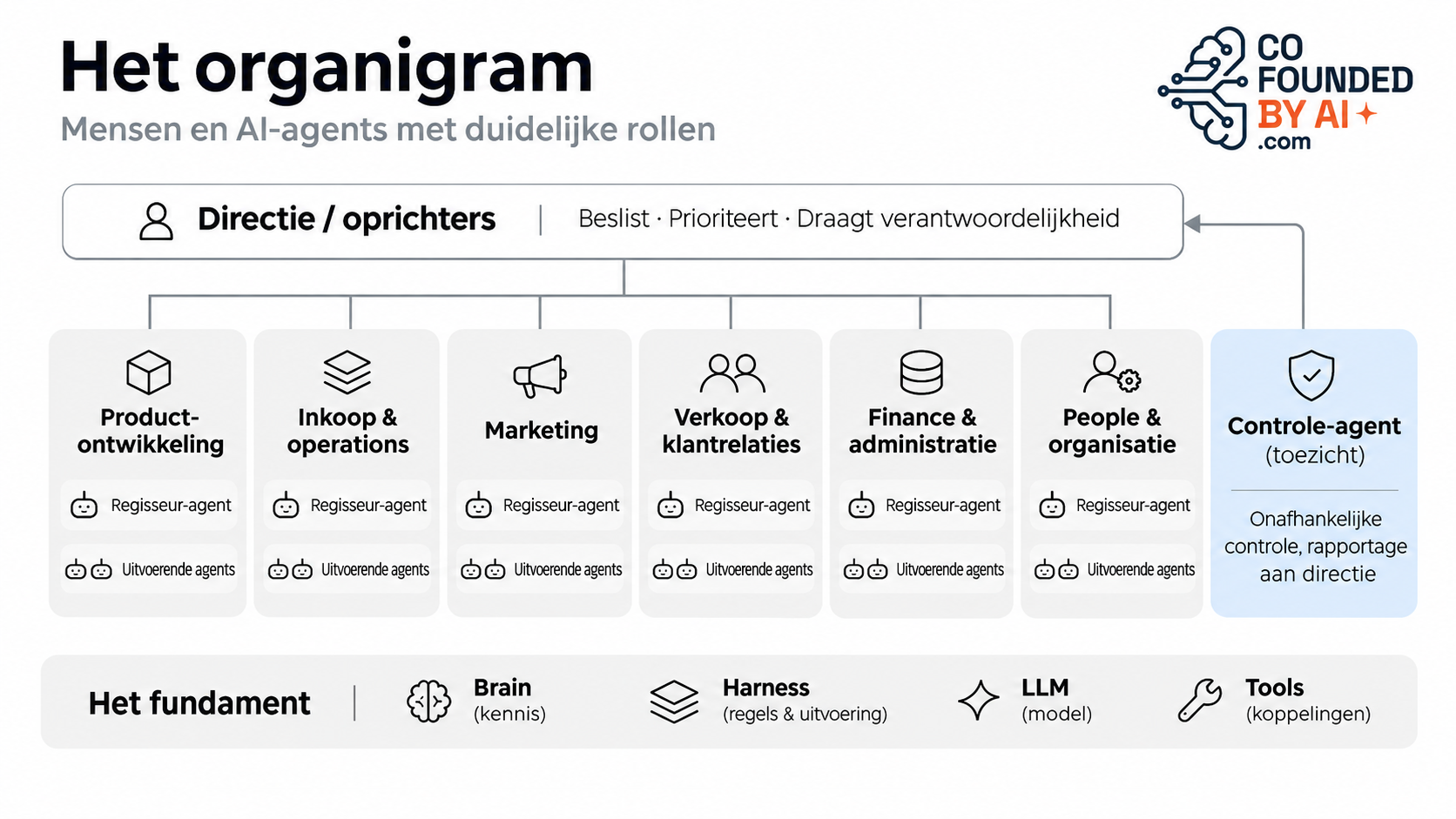 Visual: The organigram with people and AI agents
The organigram of an AI-native company. Leadership decides; six domains, each with a director agent and executing agents; an oversight agent reports directly to leadership.
Above each domain sits a person. The domain owner sets priorities, approves proposals, and bears the consequences of errors. Jurriën focuses on marketing, content, and the website. I handle product development and procurement. Product and pricing we decide together.
Below the owner, a director agent coordinates. He distributes tasks, launches executing agents, and bundles their proposals for the owner. He reads from the Brain, writes to the inbox, and launches agents within his domain. The decision rests with the human.
Below that, executing agents do the work. One agent, one task, one passport. Each agent has a line upward, through the director to the owner.
Beside the line sits oversight. An oversight agent works like an internal auditor. He compares every passport to practice each month and reports directly to leadership, separate from the domains.
The passport locks those relationships in three fields: owner, domain, and reports to. How many agents one person can reasonably guide depends on error costs. Twenty agents writing concepts demand different design than twenty agents with payment access. An owner shepherds many light agents or a handful of heavy ones.
Six Domains
At co-Founded by AI, we work with six domains. Product Development covers customer research, concepts, design, testing, and improvement. Procurement and Operations handles suppliers, production, quality, inventory, logistics, and returns. Marketing focuses on positioning, brand, content, campaigns, the website, and reach. Sales and Customer Relations covers leads, sales, wholesale, customer service, and retention. Finance and Administration manages accounting, payments, cashflow, budgets, and reporting. People and Organization focuses on roles, collaboration, onboarding, and development.
Brain, Harness, models, and Tools support all six. Knowledge belongs in the foundation.
A director agent only comes into play when the work demands it. Jurriën and I each currently oversee multiple domains. As volume and interdependencies grow, we'll add a director.
What Our Own Experiment Teaches
Our own sequence runs backward. We built the Harness first and filled in the passports two weeks later. That immediately exposed outdated instructions, unnecessary integrations, and fuzzy model choices. The lesson: start with organization. Document who does what, what knowledge and permissions belong to each role, and who bears accountability. Then build the agents. That way, the foundation for a company where people and AI agents do the work together is solid from day one.
Four Lessons for Anyone Deploying Agents
Follow the six steps: first knowledge and agreements, then technology, finally learning and oversight. Assign a human owner to each agent and specify who they report to. Let error costs drive the intensity of oversight, with extra review and human attention for agents with significant permissions. Schedule maintenance and review, with a weekly round for knowledge proposals and an independent oversight agent comparing passports to practice.