Idea generator
It's getting serious now. We're truly starting our search for the right product to sell. No idea where this adventure will lead. We're deploying AI to the max to advise us. But ultimately, we make the call. Let's go!
1. It's heading in all directions
As is typical when two founders start planning, things scatter everywhere. We keep telling ourselves to put AI to work, but we struggle to let go. We dream up products ourselves, quickly check Kickstarter, or think about what we need. Structured, it's not.
2. The machine
This won't work, we need structure. We sketch out an idea generator: a machine to help us pick the right product. 95% AI, 5% us. Here's the concept:
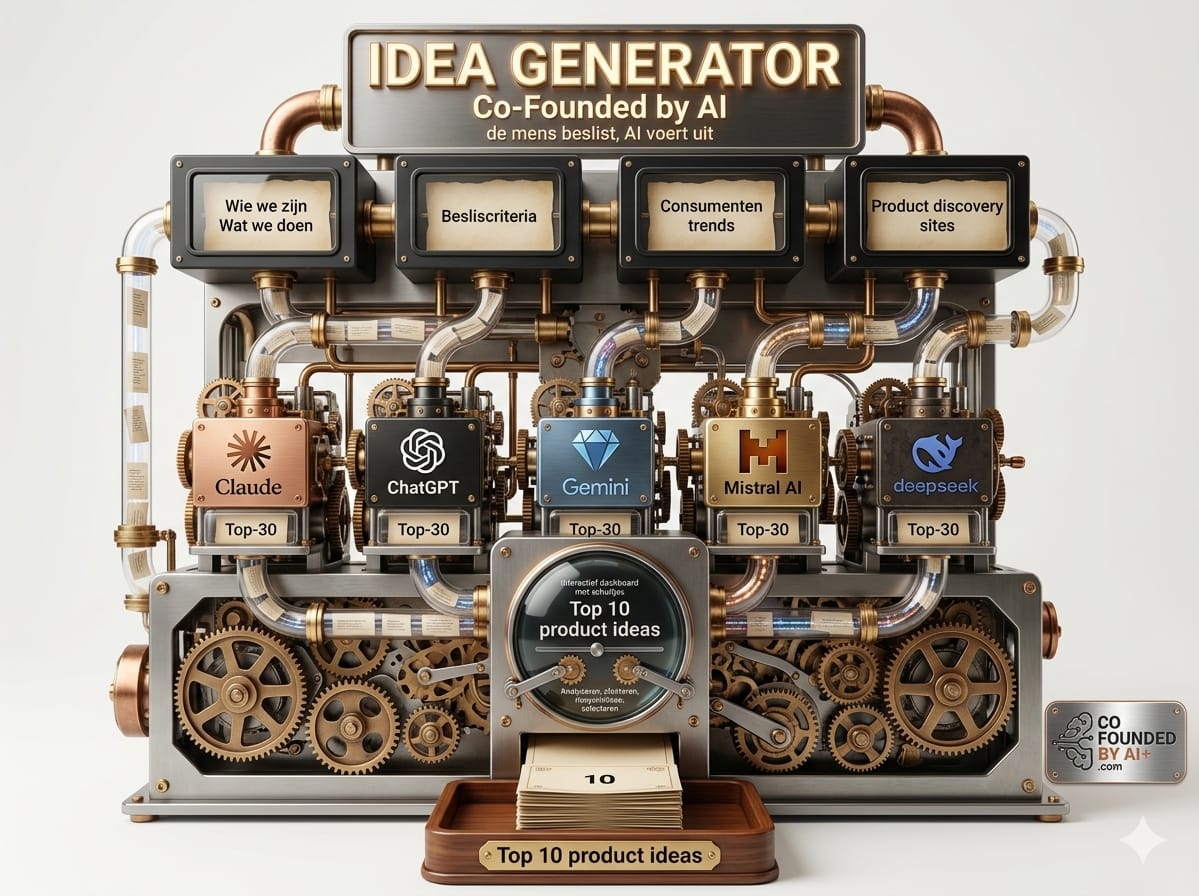
Four major input streams at the top:
- Who we are and what we do. AI pulls this from our website and design system.
- Decision criteria. Our list from a week earlier, enhanced by AI. Remember, we'd missed the demand side, customer needs. In the end, we have 21 criteria plus knockout rules: no clothing, no weapons, no medicine, etc.
- Consumer trends. Based on a ChatGPT overview. What's trending in new products and consumer behavior.
- Product discovery sites. ChatGPT surveyed the major ones (think Kickstarter) and compiled an input document.
3. Five AI engines
To get the most neutral result possible, we run it through the five major AI players. Our lineup:
- Open AI with ChatGPT 5.5
- Anthropic with Claude Co-work, based on Opus 4.8
- Google with Gemini, based on Flash 3.5
- Deepseek v4 Pro
- Mistral Vibe, based on Mistral Small 4
The cream of the crop, not just U.S. players. A solid mix that will definitely yield results.
Each engine gets the same prompt. We feed in the four input streams and ask for a top-30 list of products that best fit. Remarkably fast, they all come back with ranked lists. Nice.
4. The machine: part II
Now what? We have 5 lists of 30 products. Sometimes overlapping, sometimes not quite aligned with our criteria. Products we've never heard of and others with plenty of competition. How do we turn this into gold?
We decide to actually build the machine. With Claude Code. What we need:
- Feed in the five top-30 lists.
- The machine should deduplicate and re-check against our criteria, knockouts, and banned product categories.
- Present the remaining products in a clear overview.
- Make it easy to tweak the weighting factors.
Sweet. Claude Code builds a complete idea generator, on-brand and running live in the browser. This is useful. We play with the settings and keep seeing Premium Breathing Chain at the top. Hmmm, not getting the wow factor yet.
First, some critical tweaks to our machine:
- Images: we're missing visuals. Since not all products exist, we have AI generate matching photos. Not with Claude, it's not great at that. We use OpenAI. Claude Code calls the GPT-images-2.0 API (time to get the credit card out) and generates an image for each of the 53 remaining products. Now it feels more tangible.
- Next: the weighting factors. We both want to adjust them. That means values need to live in a database. Claude Code helps set up Supabase and deploys everything live. Now we can see each other's settings.
- One last addition: favorites. We each want to mark a top-5 products (gut feeling). The result lands in a table with our top-5, the ranking, and a final recommendation for the 3 products to pick.
The machine is done. Here's the result:
We're pretty happy with this big step. But we still don't quite have the eureka moment.
5. One more round with AI
We want AI to do one final check. With a big, detailed prompt, we ask the five AI engines again. We feed them the model and results. Our question:
"What's your advice? We want to run a customer study on 3 products. Are these the right ones? Which 3 do you recommend and why? Any tips and advice per product?"
Five answers again. They're pretty similar to each other. But lots of insights and advice. We need to synthesize this. We hand the five analyses to ChatGPT:
"We had 5 AI engines advise us on a product to sell. Can you create an infographic and summary of this? In our brand style, please."
Out comes strategic advice with strengths and weaknesses for each product. Really useful. Notably: despite different reasoning styles, the AI models reach near-identical conclusions. OpenAI Codex, Claude, Mistral, DeepSeek, and Gemini all recommend the same top 3 products. Unfortunately, ChatGPT can't turn that into a glossy PDF. Claude Co-work to the rescue.
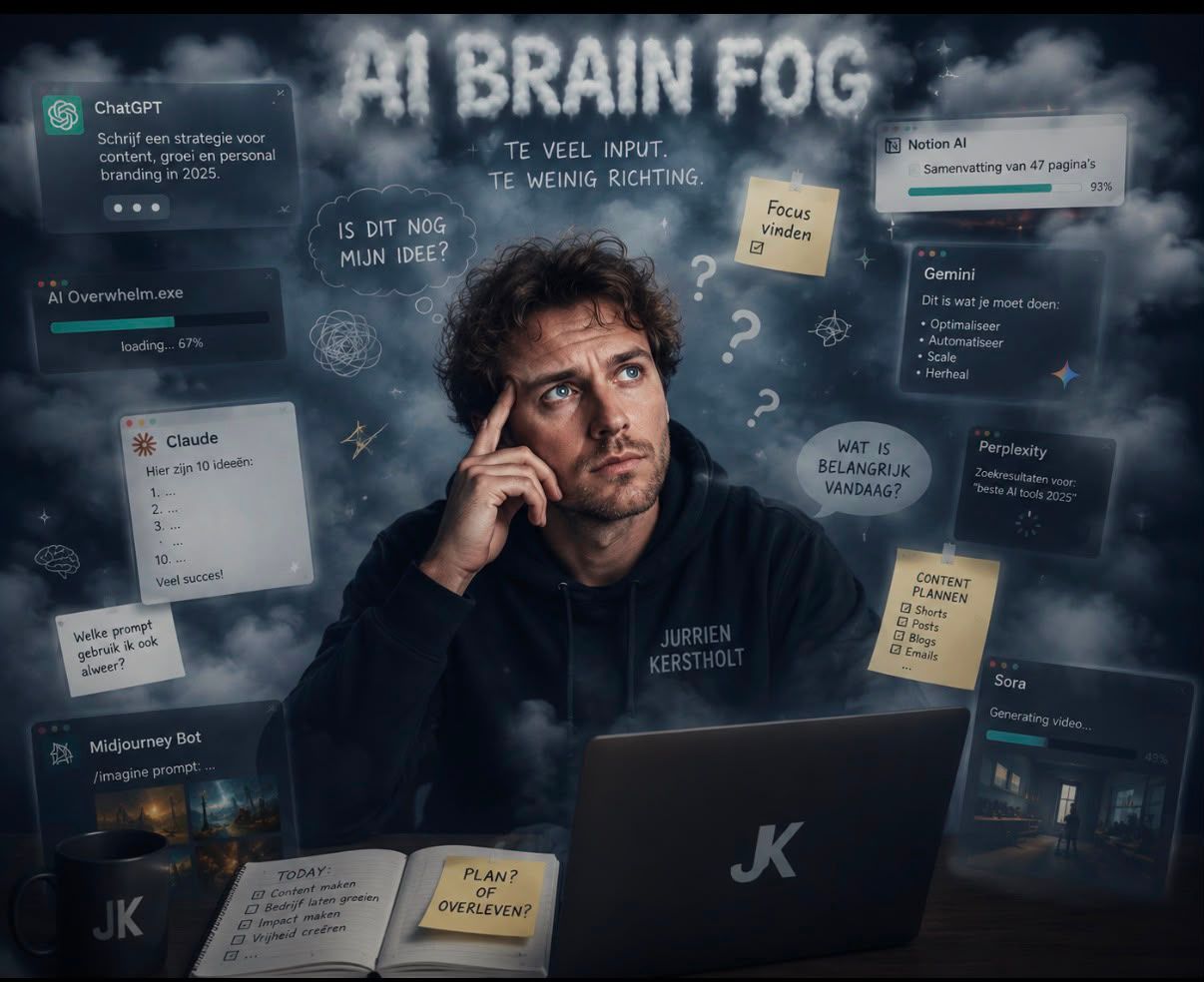
Meanwhile, 'brain-fry' looms. AI brain fry (cognitive exhaustion) is a recent phenomenon where employees become mentally overloaded from overusing and managing AI tools. Research by Harvard Business Review and Boston Consulting Group shows that constantly managing AI agents drives stress and concentration loss.
- Root cause: Constantly instructing, monitoring, and correcting AI systems.
- Impact: Higher indecision, mental fatigue, and error rates up to 39% higher.
- Fix: Take breaks, limit AI tools, run more processes manually.
6. The result
Claude Co-work delivers. We get a polished PDF with in-depth analysis and final recommendation:
- Mechanical Deep-Work Timer (Best bet)
- Screen-Free Tactile Breath Coach (Most differentiated)
- 3D Blackout Sleep Mask (Biggest market)
- Hourglass Set (Skip for customer panel)
Clear. AI advises (95%) us (5%) to move forward with these three. That means a virtual AI-driven customer study.
Read the full advisory report here: AI_Consensus_Report.pdf
We're sitting with this for now. Are these really the products to hit €200,000 in revenue? Or should we keep looking. We're uncertain. To be continued...