
We've got him
minagi has its final design. A human designer, AI, and eighteen virtual customers shape it together. The biggest debate centers on a button.
There it is. Round, with a recessed soundboard and a gold-colored dial on the front. minagi, our mechanical focus timer, has its final design!
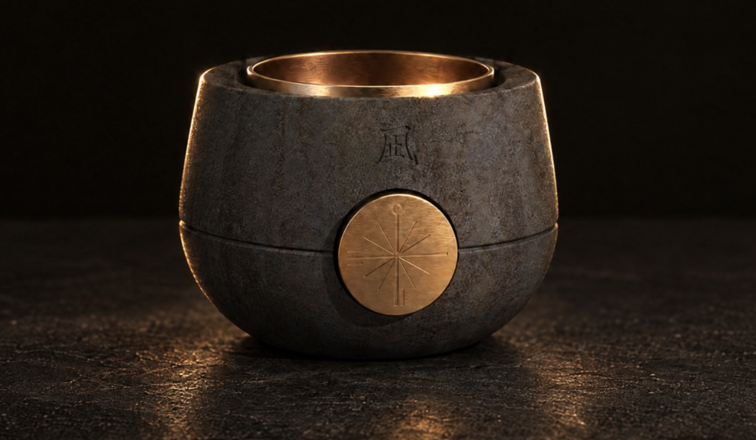 Image: minagi's final design
Behind that calm object lies a flurry of collaboration: a human designer, AI, and eighteen virtual customers. That last group has remarkably strong opinions about a button.
A designer at the drawing board
With co-Founded by AI, we're building a product company with no employees. AI handles research, design, marketing, and the rest. For minagi's form, we brought in a human designer. He got our wooden cube: a square housing, a soundboard inside, a dial on the front. The concept works. What we needed: a shape that radiates attention and calm.
The designer gave the soundboard top billing immediately, perched on the housing. Logical. At the end of your focus session, a gentle tone sounds, and that board gives minagi its character.
His redesign introduces curves. The housing takes the shape of a cushion, the board sinks into it. A composite with a stone-like finish replaces the walnut. The overall effect feels softer. The controls move to the underside, leaving the exterior free of buttons.
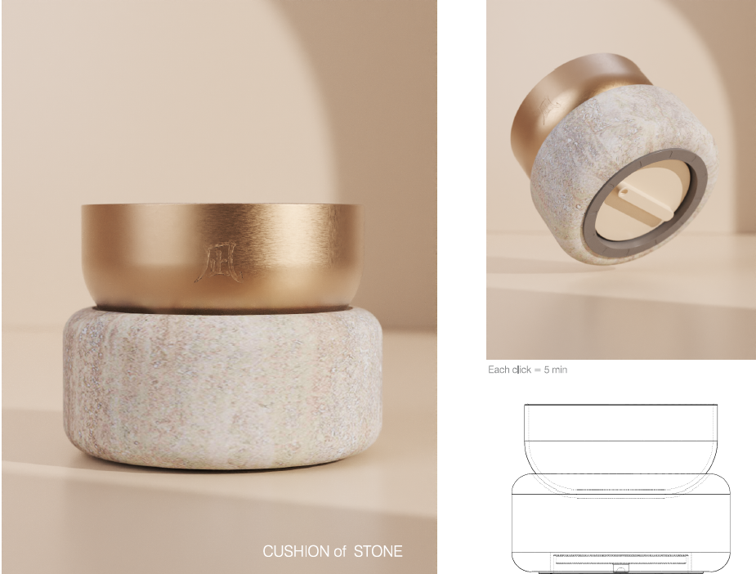 Image: minagi redesigned
Clever thinking. But the question remains: how does a customer experience it? To set the time you lift minagi slightly. During your session, the remaining time disappears from view. Does that create calm? Or just uncertainty about the countdown to your next meeting?
Eighteen virtual customers weigh in
We tested old and new designs with a synthetic focus group. AI simulated eighteen consumers, split across six customer profiles: from student to entrepreneur, from design enthusiast to busy parent. Each profile received three different personas. We compared form, material, visibility of the soundboard, and controls.
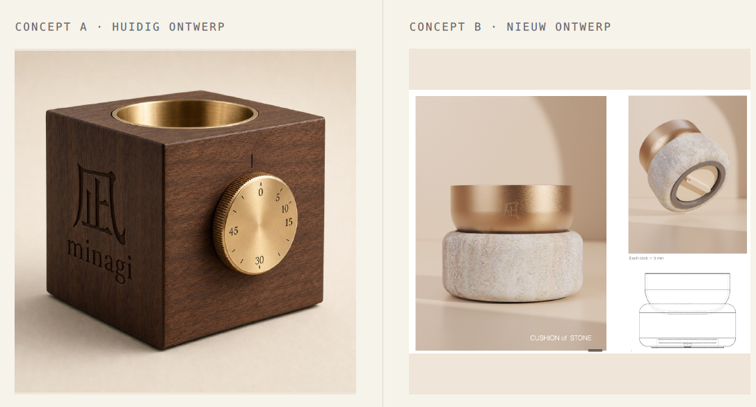 Image: old and new design compared
The results:
- Eleven chose the round version, seven the cube. Shape and a visible soundboard earned the most appreciation.
- Lifting to set the time felt acceptable to most.
- Twelve of the eighteen wanted to see the remaining time. The hidden controls prompted more objection than we expected.
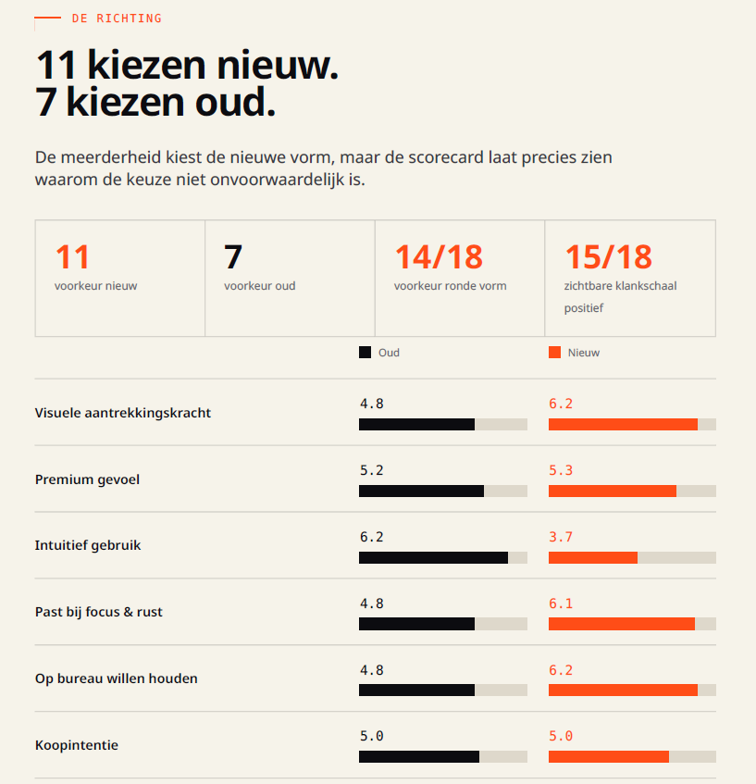
That last point holds actionable insight. A student with an hour of study time has different needs than someone taking five minutes to decompress. During a long work session, a glance at the timer helps you plan your output. Calm and time awareness both deserve a place in the design.
One caveat applies. These numbers reflect reactions that AI itself generated. They surface research questions and sharpen the brief. Real statements about real customers require testing with real people. AI noted that boundary itself: weight, temperature, and texture demand hands on a physical product.
The final design
We fed the insights back to the designer. The result combines the best of both rounds: the round housing and recessed soundboard, with a visible dial on the front. Calm on top, visibility up front.
The production drawing now moves forward with the supplier, including the strike mechanism and material finish. The design is set. Physical prototyping follows.
Claude's kitchen timer
A fun detour. We asked Claude to design one himself based on the insights: round, with time always visible. Claude dutifully delivered a wooden kitchen timer. Only the soundboard, minagi's heart, he forgot entirely.
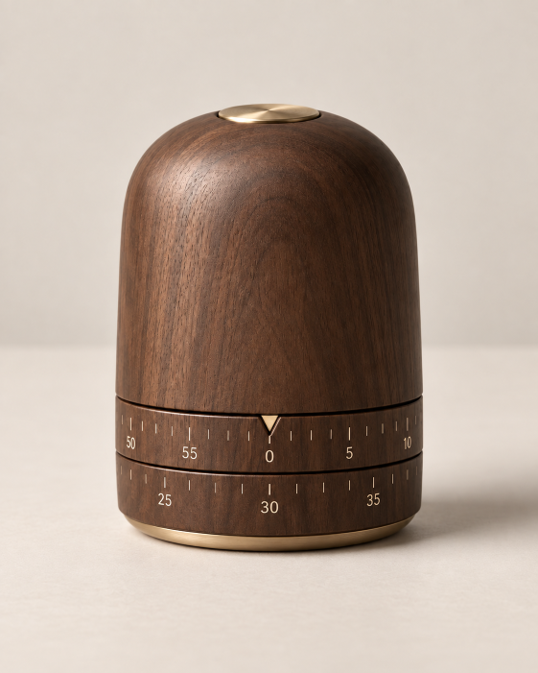 Image: Claude's version of minagi
That makes the role division in this phase crystal clear. AI asks sharp questions about a design. We write the brief, weigh the feedback, and decide. The designer translates those decisions into a coherent and beautiful object.
What you can do with this
Give AI something concrete to evaluate. Present designs and use cases. Ask where controls create confusion and what adjustment helps.
Push back on objections. Behind criticism of a hidden button lies a need for time visibility. That underlying need points the way to the solution.
Test the outcome in practice. Virtual customers sharpen a design or product concept. Real users feel, turn, and listen. The first accelerates, the second decides.
Source
- Geert-Jan Smits and Jurriën Kerstholt, "Ladies and gentlemen: we've got him!", Emerce, 23 October 2026: https://www.emerce.nl/opinie/column-ladies-and-gentlemen-weve-got-him