Virtual customer research
We're launching customer research on our top 3 products. What do virtual customers say about our product?
Virtual customer research sounds like every entrepreneur's ultimate dream when you're chasing speed. No recruiting respondents, no calendar wrangling, no focus groups with lukewarm coffee and someone who's mainly there for the €50 gift card.
01 · Synthetic customer research
You feed in a target audience, product proposition, and questions. Within minutes, you're talking to artificial (synthetic) respondents who look like real consumers. That's the idea behind co-Founded by AI.
If AI helps us build a product company with minimal labor, can AI also deliver the first customer insights? Not as gospel truth, but as a quick mirror. A way to test ideas, objections, price perception, and positioning before we invest time and budget in real customer research. Our shortlist turned up players like SYMAR, Experial, Lakmoos, Evidenza, Tellet, Koji, and Jurnii, each with their own promise around speed, scale, and customer insights.
02 · The digital landscape
The landscape breaks down into roughly three flavors. On one side are platforms with synthetic respondents, like SYMAR, Experial and Lakmoos, that simulate virtual personas, panels, surveys, focus groups, or one-on-one interviews. The strength here is speed, low cost per study, and testing variants. On the other side are tools like Tellet and Koji, which interview real customers with AI assistance, so you keep human input while accelerating analysis and scale. In between are agencies and platforms that use AI for concept development, social activation, or analysis, like Jurnii and Instagram-driven research cases like Vibeday.
The upside of virtual customer research is you learn in hours what used to take weeks. There's a downside too: synthetic respondents won't buy your product, feel no social pressure, have no messy home situation, didn't sleep badly, and never irritably say, "I don't understand this question."
03 · When to use it
For early assumptions, product variants, and campaign testing, virtual research is gold. For real purchase intent, emotion, language, and surprising behavior, focus groups, one-on-ones, and surveys with actual people still seem necessary.
04 · SYMAR
Geert-Jan gets to work with SYMAR. To be completely honest, because of the monthly cost. It's not too bad. Before you know it, you're pulled into the funnel, filling in research data. But if you actually want something real, you're soon paying €99 a month.
With SYMAR you can run many studies in different research formats. It takes a few hours before you get the hang of it. You can create surveys, schedule one-on-one interviews, and run focus groups. All with artificial personas you can easily generate. To do that, you first set up AI customer segments, then SYMAR automatically creates 10-50 synthetic personas within that segment for you.
- AI segments: Define target audience segments with demographic distributions and generate respondent pools for large-scale research
- AI personas: Create and manage artificial personas representing your target audience, decision-makers, and ICPs (ideal customers)
- AI moderators: Configure AI moderators to guide discussions in focus groups and synthetic interviews
05 · Research questions and personas
Using Claude/ChatGPT, we rapidly generate dozens of questions for three research types:
- Focus group
- One-on-one interviews
- Surveys
We create the artificial target audience segments with ChatGPT. That produces beautiful stereotypes (segments). Input is the three product sheets from our top 3 products. We arrive at these personas.

- The urban creative professional
- The ambitious Dutch Tech entrepreneur
- The wellness-selfcare buyer
- The overloaded parent professional
- The premium design buyer (rejecter role)
- The university student
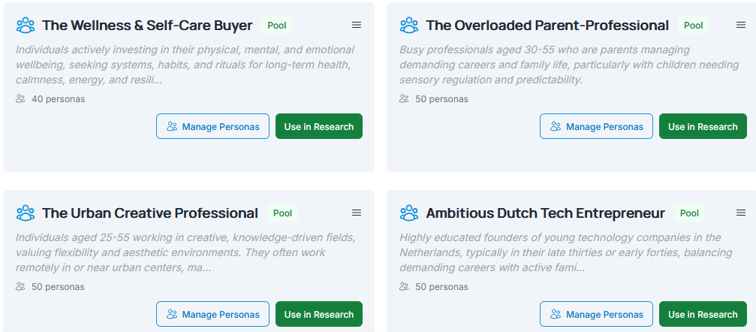
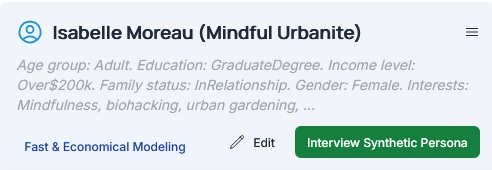
For each segment, SYMAR automatically creates 50 individual virtual people with specific age brackets, income, family status, gender, and interests.
We score on the following:
- Top 5 reasons to buy and top 5 reasons not to buy (with direct quotes)
- Most and least promising target segment
- Best positioning and best ad angle
- Biggest credibility problem
- Most desired product feature and key copy hooks
- Likelihood of gift purchase and sharing/word-of-mouth
- Relative price position versus the other two products (not absolute price)
- Spread of responses plus named minority views
- Recommendation: kill/improve/test further/launch validation
07 · The AI vertigo begins
What makes this research extra interesting isn't just the outcome, but how it unfolds. A synthetic focus group doesn't work like a simple questionnaire where AI spits out standalone answers. You see a conversation structure emerge with initial responses, follow-up questions, responses to follow-ups, and reactions to others. In other words: AI personas give their own initial response, then an AI moderator asks follow-ups, then the personas deepen their answers and also react to each other's insights.
At first, it feels almost absurd. AI participants talk to each other, guided by an AI moderator, about a product that was earlier conceived by AI. And somewhere in that digital circle, something useful emerges: nuance. Not as a replacement for real customer research, but as a fast way to test assumptions, find language, and spot blind spots.
For our experiment, that fits perfectly. AI doesn't just execute tasks; it also organizes counterargument. That might be the biggest shift: you might not get faster answers, but you get better questions faster.
07 · SYMAR outcome
What comes out of a SYMAR focus group study aimed at one of the 3 chosen products? A 138-page PDF! "This synthetic focus group examined 7 questions with 19 participants and generated 570 total interactions: 437 direct answers, 133 reactions, and 152 follow-up questions. The discussion was automatically processed." Luckily there's the option to have AI analyze the results. A summary of 3 pages quickly rolls out. The findings are quite sobering, specifically for The Dual.
- The combination of two functions: focus timer and alarm is seen as two products crammed together rather than one cohesive product.
- The sound scale as a connecting element resonates as a transition ritual, though some participants ask for proof and measurability.
We also run the other types of virtual research (surveys and one-on-one interviews) and do this for all three products. We extract super valuable information. It lets us define and write up the products much more sharply in the product sheets. Time to make a final choice.
But first we feed the same surveys and personas into Claude Cowork. Better safe than sorry.
Geert-Jan Smits & Jurriën Kerstholt - Founders co-Founded by AI